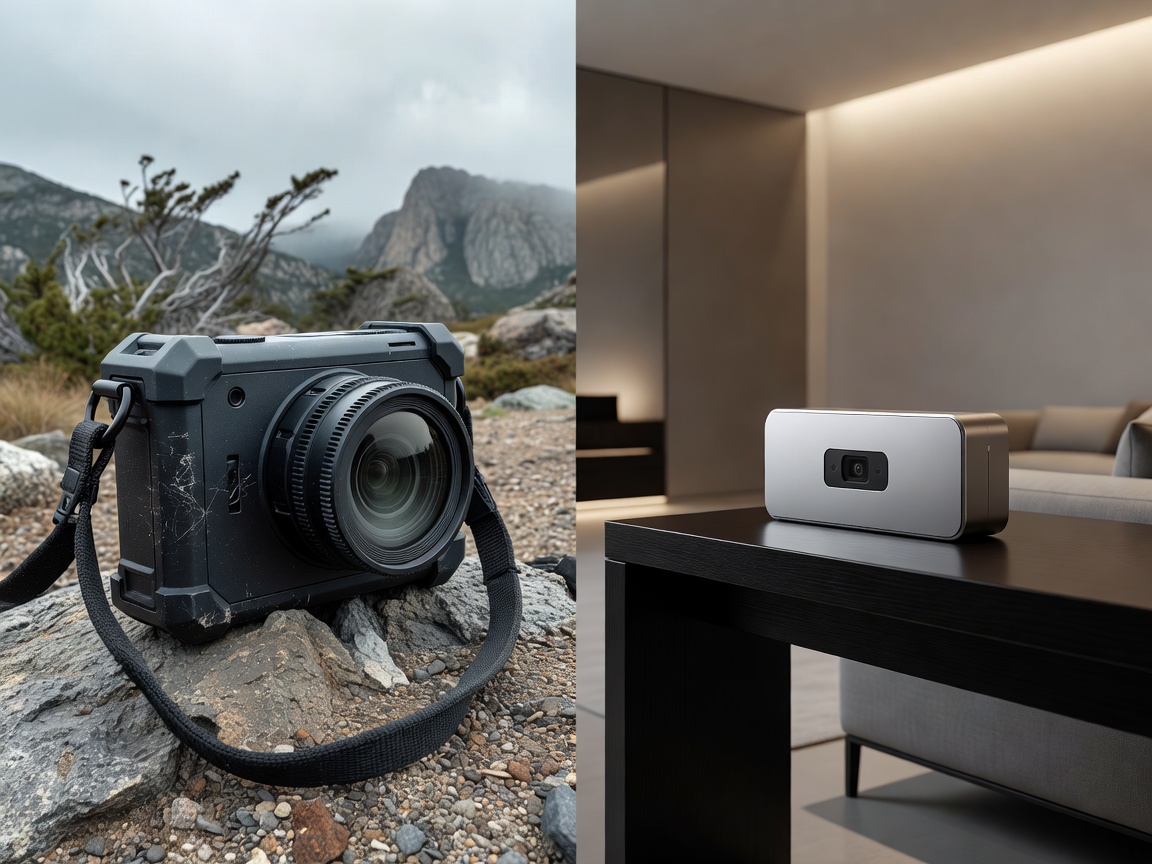
While the internal sensors of surveillance cameras might share similar technology, the housing, lens configuration, and software features of indoor and outdoor cameras are distinctly optimized for their respective environments. Mixing up the application of these devices leads to hardware failure, poor coverage, and severe privacy implications.
Hardware Durability: IP and IK Ratings
The most immediate difference is physical durability. Outdoor cameras are subjected to rain, snow, UV radiation, extreme temperature fluctuations, and potential physical tampering.
To quantify environmental resilience, the industry uses Ingress Protection (IP) ratings. A standard outdoor camera should feature at least an IP65 rating, indicating protection against dust and low-pressure water jets. Higher-tier models push into IP66 or IP67 territories, meaning they can withstand high-pressure jets or temporary submersion.
Furthermore, outdoor models often feature IK ratings for vandal resistance. An IK10 rated dome camera can withstand the impact of a 5kg mass dropped from a height of 40cm, crucial for cameras mounted in accessible exterior locations.
Indoor cameras generally lack these ratings entirely. Their plastic housings are designed for aesthetics and compact profiles, prioritizing seamless blending into home decor over ruggedness.
Field of View (FOV) and Lens Constraints
Because the spaces they monitor vastly differ in scope, their optical properties differ too.
- Outdoor Lenses: Outdoor environments are expansive. Cameras typically utilize wide-angle lenses (ranging from 100 to 140 degrees) to capture broader areas like driveways or gardens. They also require dynamic iris technology to instantly adjust between blinding direct sunlight and deep shadows.
- Indoor Lenses: Rooms have hard boundaries (walls). Indoor cameras often utilize moderate wide-angles to capture a whole room from a corner, but avoid excessive wide-angles to prevent "fisheye" distortion which makes identifying faces at close range difficult.
Privacy Considerations
Deploying surveillance inside a home introduces significant privacy hurdles. Modern indoor cameras frequently integrate physical privacy shutters—mechanical shields that cover the lens when the system is disarmed or the user is home. These provide a critical optical guarantee of privacy that software toggles cannot match.
Outdoor cameras prioritize constant vigilance. They do not feature privacy shutters and are instead designed with robust anti-tampering software that sends immediate alerts if the lens is covered or the unit is moved.
Audio Integration Variations
Two-way audio is common on both, but their execution differs. Indoor cameras use sensitive microphones designed to pick up conversational tones or distinct sounds like crying babies or breaking glass within an enclosed acoustic space.
Outdoor cameras must fight wind, traffic noise, and rain. They utilize advanced noise-canceling algorithms and high-decibel speakers designed to act as deterrents—projecting loud alarms or voice warnings across large distances.
Conclusion
Never mount an indoor camera outside; condensation and exposure will rapidly destroy the circuitry. Conversely, while an outdoor camera can function inside, its bulky design, lack of physical privacy controls, and cost overhead make it a poor choice for interior deployment. Selecting purpose-built hardware for each zone ensures longevity and respects the unique requirements of the space.